
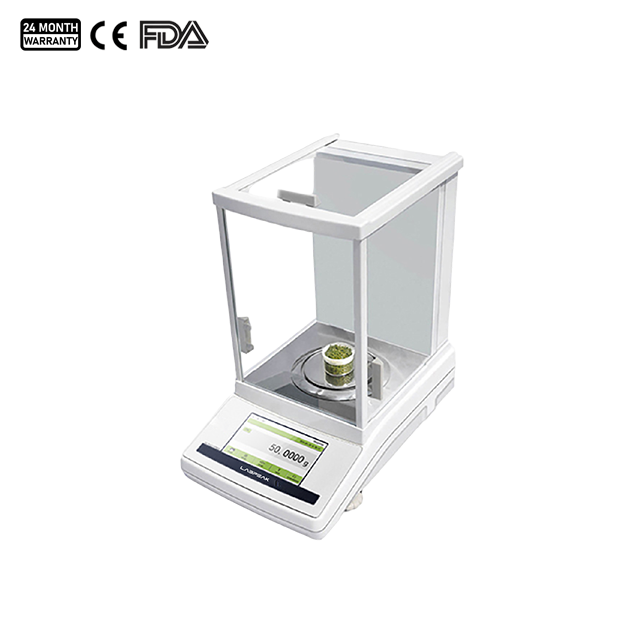
- Model: BAL-PIT2004; BAL-PIT2204
- Capacity (g): 200 220
- Readability (g): 0.0001
- Min Weighing (g): 0.0004
- Stable Time: ≤3s
- Display: LCD (white backlight with black font)
0.0001g Electronic Analytical Balance, Internal Calibration
The compact structure, stable performance, and fast response make it ideal for demanding environments such as research labs, pharmaceuticals, and quality control. With reliable data output and flexible connectivity options, it supports efficient and accurate daily weighing tasks.
0.0001 Analytical Balance Feature:
- High-precision measurement for reliable and repeatable results.
- Built-in internal calibration system ensures accuracy with one-touch operation.
- Touch panel interface provides simple, fast, and user-friendly control.
- Rapid stabilization improves efficiency in routine weighing tasks.
- Enclosed draft shield minimizes environmental interference for better accuracy.
- Supports data communication with external devices for easy data management.
0.0001g Analytical Balance Specification:
| Model | BAL-PIT2004 | BAL-PIT2204 |
| Capacity(g) | 200 | 220 |
| Readability(g) | 0.0001 | |
| Min Weighing(g) | 0.0004 | |
| Stable Time | ≤3s | |
| Display | LCD (white back light with black font) | |
| Pan Size | Φ80mm | |
| Operation Temp | 5-25℃ | |
| Repeat Ability | ±0.0002g | |
| Linearity | ±0.0003g | |
| Draft Shield Size(mm) | 240x190x265 | |
| Cal.Weight | Internal Calibration | |
| Standard | RS232 | |
| Option | RS485, Printer | |
| Sizes(W×D×H)(mm) | 340x210x350 | |
| Shipping Size (W×D×H)(mm) | Inside: 415x285x430; Outside: 475x315x485 | |
| N.W./G.W. (kg) | 8/11 | |
Different between external calibration vs internal calibration
The difference between external calibration and internal calibration in a weighing balance is mainly in method, convenience, and accuracy control:
External Calibration:
Method: Uses certified external weights placed manually on the balance
Operation: Requires user intervention
Flexibility: Can verify accuracy across different weight ranges
Cost: Lower (no built-in calibration system)
Application: Suitable for standard lab use and periodic verification
Internal Calibration:
Method: Uses built-in calibration weights inside the balance
Operation: Automatic or one-touch calibration
Convenience: Fast and easy, no external weights needed
Stability: Reduces human error and improves consistency
Cost: Higher due to integrated system
Application: Ideal for high-precision or frequent calibration needs
How should the balance be installed?
Place the balance on a stable, level, and vibration-free surface. Keep it away from drafts, direct sunlight, and heat sources. It is recommended to use a dedicated weighing table and ensure proper leveling before use.
Is it sensitive to environmental conditions?
Yes, factors such as temperature fluctuations, air currents, humidity, and vibration can influence weighing results. For best performance, operate the balance in a controlled environment with minimal disturbances.
Can it connect to external devices?
Yes, the balance can be connected to external devices such as printers or computers via communication interfaces. This allows for convenient data transfer, recording, and report generation.
How do I ensure accurate results?
Allow sufficient warm-up time before use, perform regular calibration, and place samples carefully at the center of the pan. Avoid touching samples with bare hands and minimize environmental interference during measurement.
WHY Labpeak
- 24 Months Limited Warranty
- CE & FDA Standards
- 1-2 Days Handling and 7-30 Days Shipping
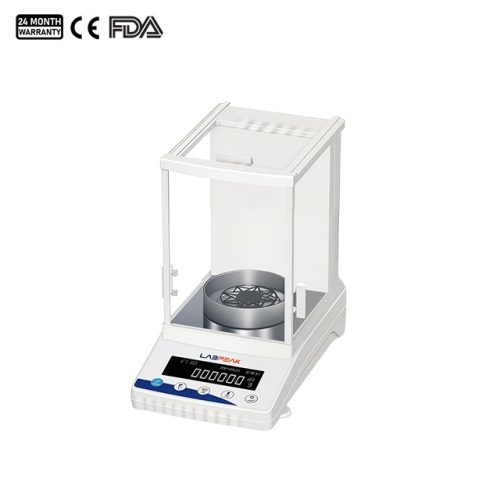
Get Social